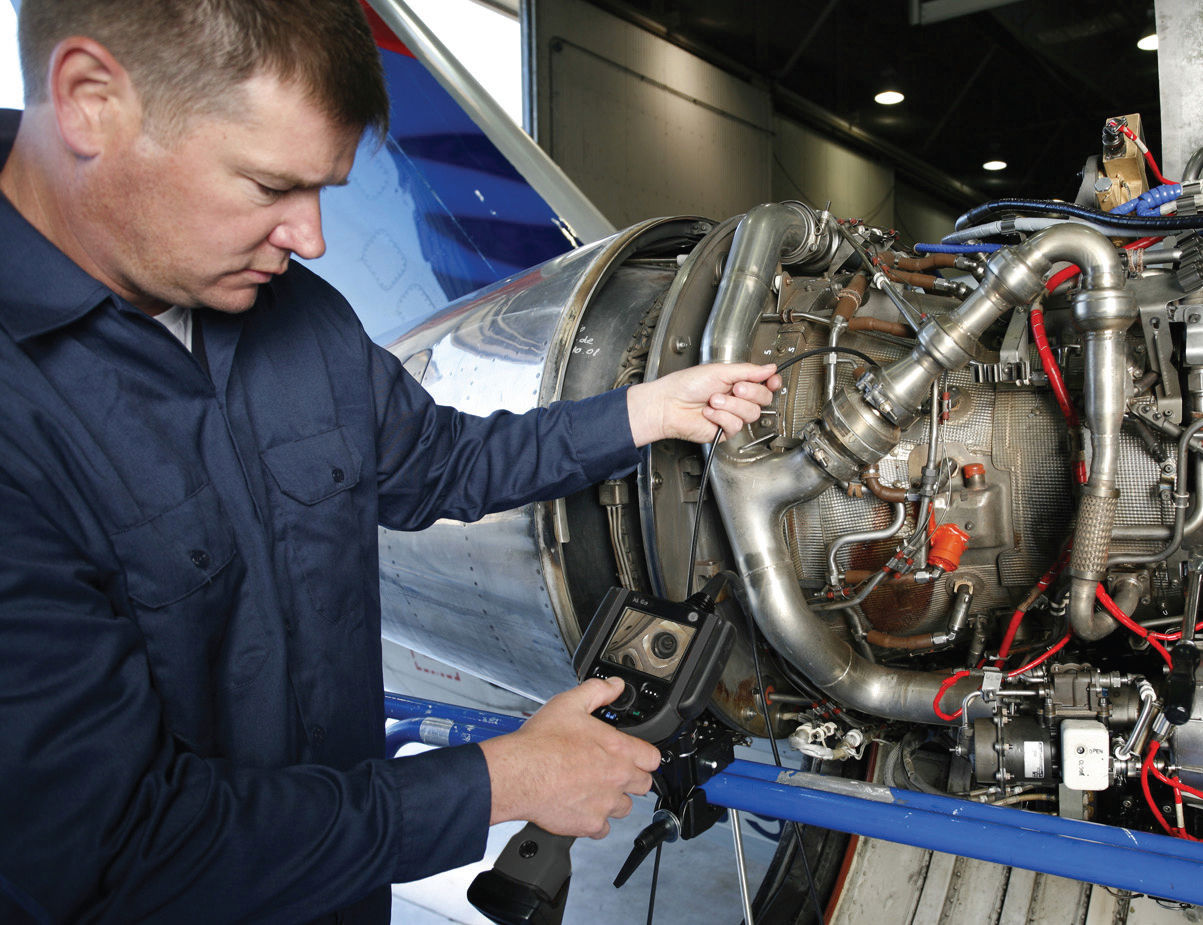
Borescopes are important visual tools. It allows seeing images of invisible areas in the aircraft engine. There are three categories of scopes available.
Rigid scope
These are non-flexible inspection scopes. You can access remote zones that don’t need flexibility. Image clarity is the advantage of rigid scopes. Optics are used to project images on the eyepiece. Therefore, the resolution is clear than video or fiberscopes. Inflexibility or non-maneuverability is its major disadvantage.
Fiberscopes
Fiberscope makes use of fiber optic strands for image projection from the probe tip to the eyepiece. Flexibility is its plus point. You can bend it in areas that rigid scope is unable to reach. You can maneuver the probe head once you are positioned in place to get a full surrounding view.
You get fiberscope in as small as 0.025” diameter, which allows you to coolly see inside the turbine blades hole. You cannot get this small diameter in a video scope.
Video scope
The operation and appearance of the video scopes are similar to the fiberscope. The latest is a hand-held borescope camera. On usaborescopes.com, buyers get to choose a video scope that is a compact, small, versatile, reliable, and affordable visual device.
CCD or charged coupled device is used to capture images on the cope’s distal tip. The image is electronically transported through the scope to the CCU or camera control unit.
Video scopes have revolutionized the borescope inspection systems. The image files are digital, so you can store them with ease for future reference. It can be emailed for instant feedback from someone at remote locations.
Tips for better borescope inspection technique
Get familiar with your equipment
Read the user’s manual and learn the best way of operating the equipment. Learning and practice will help to maneuver comfortably and beware of its limitations. Get to know how your equipment operates to make the most of your investment.
Beware of the lighting
If your task is outside the house in bright sunlight, then allow your eyes to adjust before looking inside the scope. Bright light impacts the vision of clear images on a few display screens. Perform borescope inspection inside a hangar for optimal clarity.
Use the right tool
Scope with poor optics along with dim lighting can be extremely frustrating. It reduces the chances to detect defects. Therefore, ensure to have equipment in good working condition.
- Dye-penetrant inspection
Some borescopes have canisters attached. It allows applying liquid penetrant in remote areas via fiberscope. The scope has a guide cable that permits efficient UV light transmission. The image gets viewed on an LCD screen between normal lighting suitable for visual review and black light for dye penetrant assessment.
- Working tool
Some of the tools for borescope available are forceps, loop snares, magnets, grabbers, and measurement gauges. These working tools empower you to eliminate foreign things from inside the engine and even in some remote zones without any need to disassemble.
- Defect measurement
The 3-D stereo defect dimension helps to calculate precise measurements instantly. The image gets saved to a file for re-measurement, if necessary.
Based on needs and budget, you need to discover a suitable scope. Make sure the scope chosen is flexible and scalable.
 Fav-Fashion